
Plural Cities: Modeling Diverse Public Space Preferences at Scale
2025-08-10
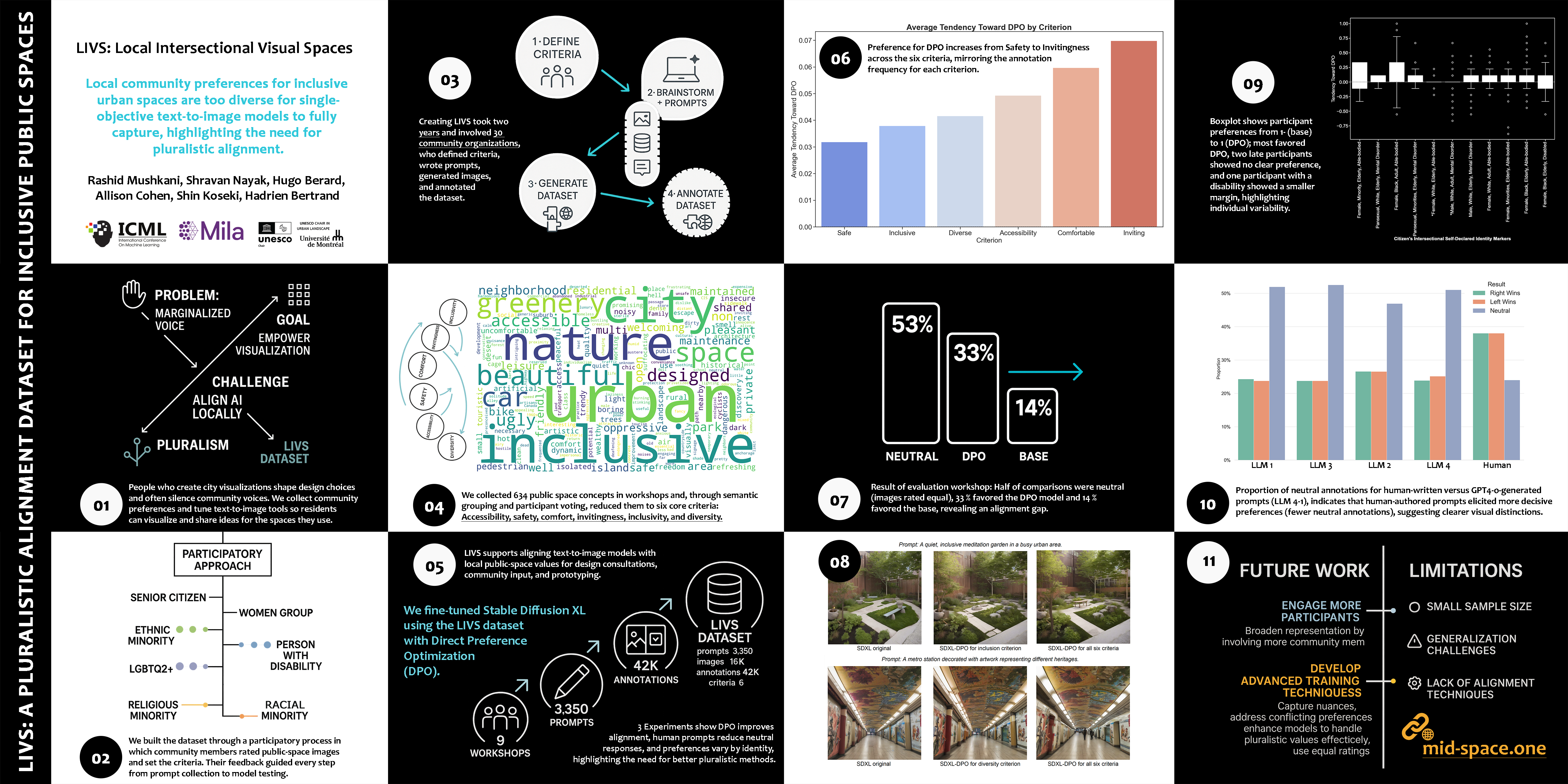
LIVS begins from a basic point: no single image of a "good" city can stand in for everyone who lives in one (Mushkani et al., 2025; Nayak et al., 2024).
Read on arXiv · OpenReview (ICML 2025) · Project & Dataset
Why This Dataset Exists
Most alignment work in generative AI still assumes that preference can be compressed into one clean signal. That assumption is especially brittle in urban design, where accessibility, safety, comfort, culture, diversity, and belonging are often felt differently by different groups. LIVS was designed to keep that plurality visible rather than hiding it inside an average.
The project also builds on lessons from MID-Space, which demonstrated the value of aligning image-generation tools with localized, community-defined criteria instead of generic design defaults (Nayak et al., 2024). LIVS pushes that logic further by focusing explicitly on pluralistic, intersectional preference modeling.
What LIVS Contains
The dataset was developed through a two-year participatory process with 30 community organizations in Montréal and translates 634 community-defined concepts into six working criteria: Accessibility, Safety, Comfort, Invitingness, Inclusivity, and Diversity (Mushkani et al., 2025). It includes 13,462 images and 37,710 pairwise comparisons, creating a benchmark for asking how different publics want public spaces to look and feel rather than how a model assumes they should look.
To test that premise, the study used Direct Preference Optimization to fine-tune Stable Diffusion XL and then evaluated the tuned model on new comparisons. The result was not a perfect pluralistic model. It showed where alignment improves, where it remains unstable, and where disagreement itself carries information.
What The Findings Suggest
One of the most revealing findings is the persistence of neutral ratings in the evaluation data. I do not read that as failure. I read it as evidence that public values are often heterogeneous, visually subtle, and resistant to single-objective optimization. That is precisely why pluralistic alignment matters.
The study also shows that identity matters, that human-authored prompts produce more distinctive outputs than generic prompt generation, and that improvements vary by criterion rather than arriving all at once. In short, the work points toward a form of alignment that treats difference as a design condition rather than a problem to be averaged away.
Where This Can Be Used
For public engagement, LIVS offers a way to generate options that mirror local priorities and expose trade-offs in workshops. For urban design, it offers faster iteration without severing design from community judgment. For AI research, it offers a benchmark that treats plural values as first-class rather than secondary constraints.
Visuals


More: arXiv · OpenReview / ICML 2025 · Project & Dataset (mid-space.one)
References
Mushkani, R., Nayak, S., Berard, H., Cohen, A., Koseki, S., & Bertrand, H. (2025). LIVS: A pluralistic alignment dataset for inclusive public spaces. Proceedings of the 42nd International Conference on Machine Learning. https://arxiv.org/abs/2503.01894
Nayak, S., Mushkani, R., Berard, H., Cohen, A., Koseki, S., & Bertrand, H. (2024). MID-Space: Aligning diverse communities' needs to inclusive public spaces. OpenReview. https://openreview.net/forum?id=kyfkMRT4Ao